Home — Training Resources — Tattoo Machines
— GUIDE / TOOLS —
Tattoo Machines for Fine Line: Rotary, Pen and Coil
A fine line is only as steady as the machine behind it and the hand guiding it. This guide compares the three machine families you will meet, explains stroke and voltage in plain terms, and shows why ergonomics and control count for more than any spec sheet.
— THE SCALE —
| Coil
|| Rotary
||| Pen
— Stroke & voltage
— Ergonomics & control
— 01 / MACHINE FAMILIES —
Three ways to move a needle
Every tattoo machine does one job: drive the needle in and out of the skin at a consistent rhythm. What differs is how that motion is made, and that changes the sound, the weight in your hand and the way the needle meets the skin.
FAMILY I
Coil machines
Electromagnetic coils pull an armature bar down, a spring returns it, and the needle bar follows. Coils are tuned by hand, usually set up as either liners or shaders, and give plenty of feedback through their distinctive buzz.
— Responsive and traditional
— Needs regular tuning and care
— Often heavier in the hand
FAMILY II
Rotary machines
A small motor turns a cam that converts rotation into a straight up-and-down stroke. Rotaries run smoothly and quietly, and many are built to switch between lining and shading without retuning.
— Smooth, even motion
— Lower maintenance
— Some designs add soft give
FAMILY III
Pen-style machines
A rotary mechanism housed in a slim, pen-shaped body that takes needle cartridges. Many run wireless. The grip feels close to a drawing tool, which is why pens are common in fine line studios.
— Familiar, pencil-like hold
— Quick cartridge changes
— Battery or cable options

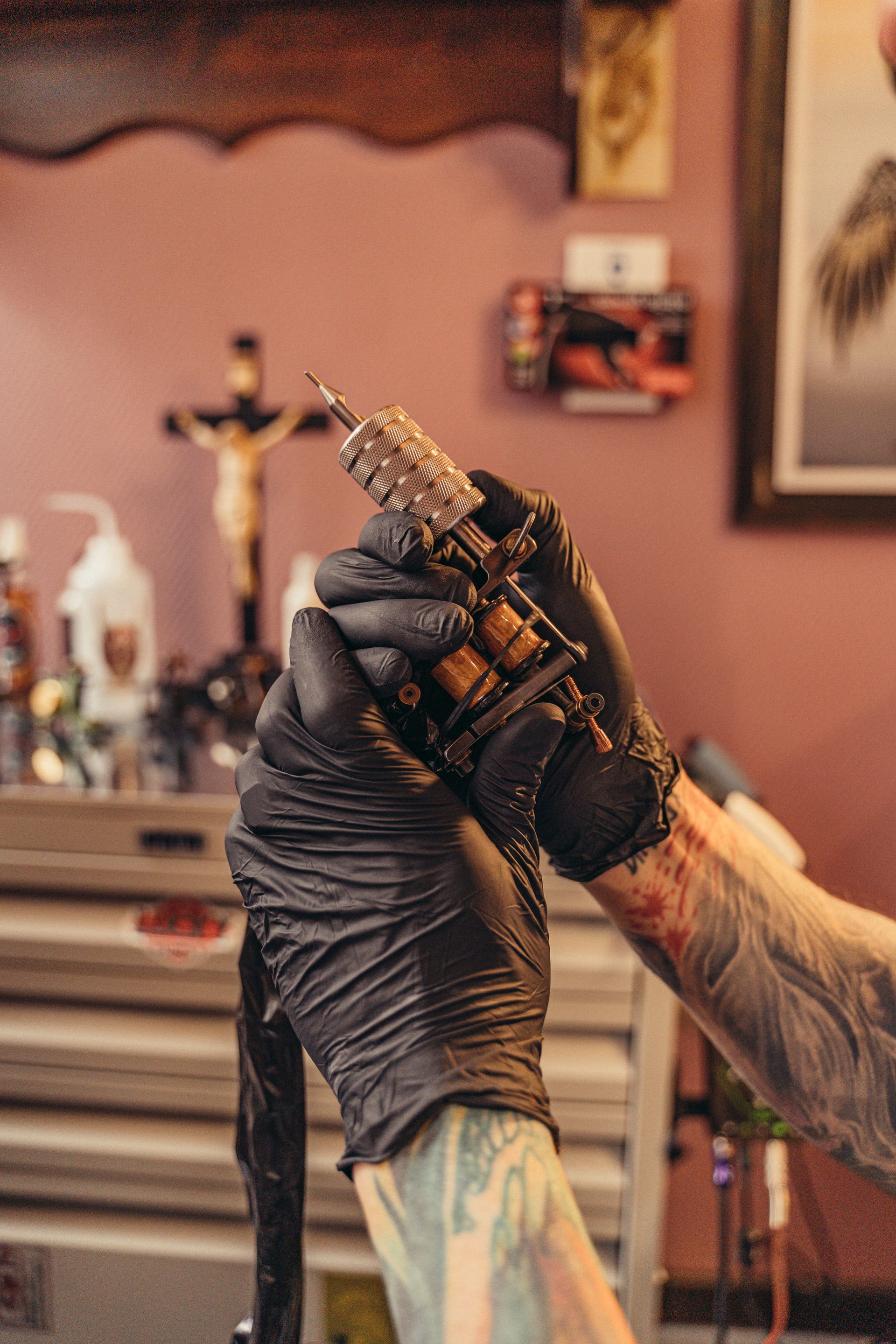
Reference photograph: a tattoo machine held ready in the hand
— 02 / STROKE & VOLTAGE —
Stroke and voltage, in plain terms
Stroke: how far the needle travels
Stroke is the distance the needle moves on each cycle. A shorter stroke tends to feel softer and deposits ink more gradually. A longer stroke pushes with more force. For fine line work, what matters is choosing a stroke you can control and matching your hand speed to it, not chasing a particular setting.
Voltage: how fast the machine runs
Voltage from the power supply sets how quickly the machine cycles. On a coil it also affects how the tuning behaves. If the machine runs fast while your hand moves slowly, you risk overworking the skin. If your hand moves faster than the needle can keep up, lines skip and break.
Give: hard hit or soft hit
Some machines drive the needle rigidly, while others have a little give that cushions each hit. Neither is automatically better. Each one asks for a slightly different touch, and learning to feel that difference is part of Needle & Technique Training. Pair this with our tattoo needles guide.
— 03 / ERGONOMICS —
Why control beats specification
Fine lines show every wobble. Over a long session, a machine that is too heavy, badly balanced or dragging on its cable wears out your wrist, and tired hands pull uneven lines.
Before you think about features, check how the machine sits in your hand:
— Weight and balance point
— Grip diameter and texture
— Cable drag or battery weight
— Vibration reaching your fingers
— Space to brace your hand on the skin
— 04 / BEFORE YOU BUY —
Learn the machine before choosing one
The best machine for fine line is the one you can set up correctly, hold comfortably and run at a speed your hand can match. That comes from supervised practice, not from a product page. Our Tattoo Machine Training covers setup, handling and control for clean line work, and Tattoo Hygiene & Safety covers how to prepare and barrier your machine safely.
Keep reading with How to Pull Clean Tattoo Line Work, or contact us with a question.