— INDEX —
i Expertise
ii Approach
iii Feedback
iv Philosophy
— TRAINERS / TEACHING —
Our Fine Line Tattoo Trainers
Fine line work is learned beside someone who can see the fraction of a millimetre you can’t yet. Our Melbourne trainers teach the discipline the way it is practised: drawing first, then machine and needle control, then clean application, with safe studio habits running through every stage.
— i / EXPERTISE —
Where the teaching is focused
Each area of expertise lines up with a course. The trainers teach the whole range as one connected discipline, so what you learn at the drawing desk carries through to the machine, the needle and the finished line.
01 Fine Line Tattoo Course
Professional fine line tattooing from start to finish, taught as a complete progression.
02 Beginner Fine Line Tattoo Course
Patient foundations for people new to tattooing: posture, steady hands and first line drills.
03 Advanced Fine Line Training
Close critique for working artists who want tighter precision and cleaner fine detail.
04 Fine Line Tattoo Design Course
Composition, scale and placement, so a design is built to hold as a fine line on skin.
05 Tattoo Machine Training
Setting up, handling and controlling a machine for even, consistent line work.
06 Needle & Technique Training
Choosing needles on purpose, and the angle, stretch and hand speed behind a clean line.
07 Tattoo Hygiene & Safety Training
Infection control and safe studio practice, treated as part of the craft rather than an add-on.
— ii / APPROACH —
Taught in stages
Each stage rests on the one before it. You move on to the next stage once the current one is steady.
STEP A — DRAW
Line on paper
Trainers start with the drawn line: weight, direction and scale. A design that won’t hold on paper won’t hold in skin, so this is where design thinking begins.
STEP B — CONTROL
Machine and needle
STEP C — APPLY
Technique in practice
Only then does technique come together in a clean, safe working sequence, with hygiene and safety habits built in from the first station setup.
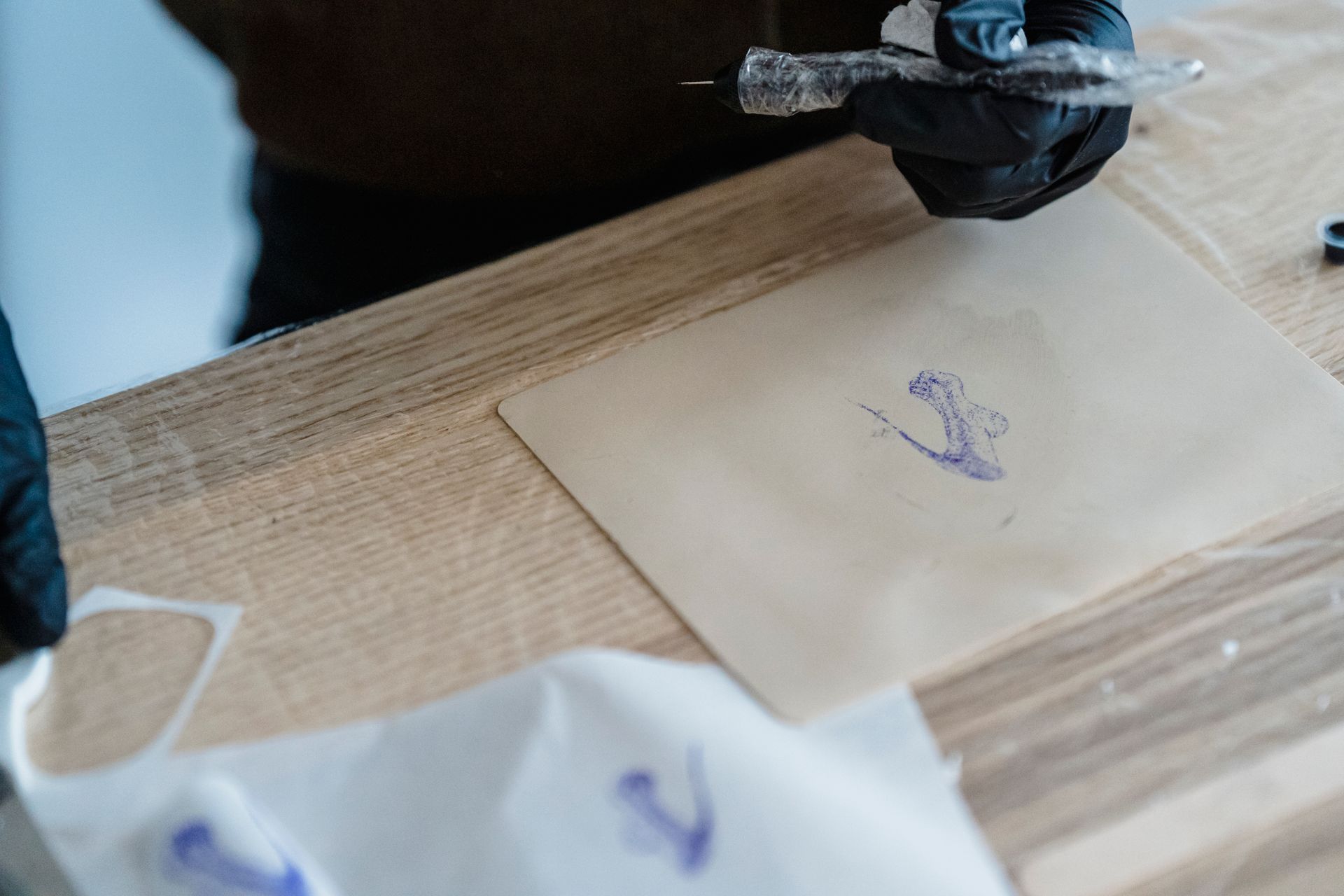
Reference: a wrapped machine held above a stencil sheet, the point where drawing becomes application.
— iii / FEEDBACK —
Three questions asked of every line
Feedback is given on the work in front of you, in plain language, while the movement that made it is still fresh in your hand. The same three questions frame every correction.
QUESTION ONE
What is holding?
Trainers name what is already right, whether that is consistent weight or a steady start and finish, so you know exactly what to repeat.
QUESTION TWO
Where does it drift?
A wobble, a blowout risk or a line that thins at the curve is traced back to its cause: angle, stretch, speed, setup or the design itself.
QUESTION THREE
What is the next drill?
Every correction ends with something to practise. That turns a comment into a habit you can carry into the next session and into our line work guide.
— iv / PHILOSOPHY —
Slow the hand until the line is certain. Speed follows precision, never the other way round.
Fine line tattoos leave nowhere to hide, so our trainers teach care before confidence. That means respect for the client’s skin, honesty about what a small design can hold, and a clean station every time. Beginners get patience and repetition. Working artists get direct, detailed critique. Both are held to the same standard for the finished line.
To see where this approach leads, read What Is Fine Line Tattooing? or browse the student work gallery.
— NEXT STEP —
Ask who will be teaching you
Tell us where your line work is now and which course you’re considering. We’ll talk through the trainer, the teaching approach and the right starting point. Not sure yet? Read How to Choose a Tattoo Course or compare every option on the courses page.